Featured

Important Truths to Face About Making a Living Online

Photo by Domenico Loia

The state of professional work has evolved significantly over the past decade or so. For the longest time, people believed that the only way to make a living is by showing up to work every day and bringing home a salary. 

However, with developments in technology, there are now more options than ever for making a living. Today, the option of making a living online is one that many people have turned to, whether it’s freelancing, selling a product or service online, or even becoming an influencer. 

The options are endless. In fact, online work pays very well, with some workers reporting incomes up to $4,000 more per anum compared to other types of work.

Unfortunately, many people believe that all there is to making a living online is simply to have a laptop and internet connection. While this is definitely the bare minimum, keep in mind that you will need more than that. 

If you let yourself get swept up in an idealistic fantasy of what working online is like, then you may be in for a hard time. 

Here are some of the truths that you need to face about making a living online so that you can approach this as realistically as you can and succeed in turning this venture into a full-time career.

Making a Living Online Isn’t as Easy as It Looks

As with any business endeavor, there are no guarantees that you will make money, even if you follow all of the online advice to a T. 

And while there are many success stories posted online, there are also others that do not have such a happy ending. 

It is important to keep these things in mind when seeking to make a living working at home on your computer or laptop. There are new and innovative ways to make money online every day. You just have to find what works best for you and your skills. 

The key is motivation, determination, and patience. If you start with those three things, then anything is possible. 

It can be frustrating at first, but the important thing to do is to keep working at it, and not give up at the first sign of difficulty.

Work Hard Before You Can Work Smart

There’s no way around it: When you first start working online, whether as a freelancer or as an employee for someone else, you’re going to have to put in the time and effort needed to build your basic skills and knowledge base. 

Even more advanced workers are constantly learning. 

Don’t expect yourself to be able to skip straight from making no money online to making a healthy income without putting in a lot of time and hard work along the way. 

This is especially true if you’re just starting out because there’s so much information that you’ll need to learn before you can earn anything significant.

You Will Fail More Than Once

In order for you to become a successful online entrepreneur, this is vital to the process. You will learn from your mistakes and then eventually become successful. 

It is important to keep in mind that you must not give up.

Don’t get discouraged when things don’t work out. Failure is inevitable and it’s a great opportunity for you to learn what works best for you. 

It has been mentioned repeatedly that getting a foothold in the online work field is a significant challenge, and you need to hold out until you finally get that first gig to kickstart your entire career. 

However, keep in mind that even after that first gig, it does not mean that you are now immune to failure. You may fail more than once; in fact, you should expect it. 

By preparing yourself, you are able to develop the skills needed to get through any obstacles that you may encounter during your online career.

There’s No Such Thing as Instant Success

You’re probably going to have to work for quite a long time before you can achieve any level of success online. You need to be persistent, and you need to have perseverance. 

Success requires time, effort, and endurance.

There’s no such thing as instant success online. There’s no “magic bullet” solution or “get rich quick” scheme that will take your blog from unknown nobody to the next online sensation overnight. 

That’s just not how things happen in this world—at least not legally—and anyone who says otherwise is selling snake oil or trying to scam you out of your hard-earned money.

Success is not a straight line; it’s more like an upward spiral, where every end brings you closer than the last one did (even if the next start seems farther away). Keep pushing forward with small steps every day and never quit, and eventually, things will work out for you. 

It may not be as romantic as becoming an overnight success, but building up your career steadily like this is much more sustainable than waiting for that magic formula solution that will catapult you to riches. 

This is important to remember. Not everyone will succeed in making a living online. And the reason is that they think it will happen quickly and easily. 

Just because you think you have a great idea or a good product does not automatically mean that people are going to buy what you’re selling. You need to show them why your products and services are the best options for whatever problem they have, and this will take time. 

If you want to make a living online, you need to be patient, persistent and focused on the long term. It’s also important that you have self-motivation and are disciplined in working consistently on your business daily.

Finally, you need to know what you’re doing well enough that if something goes wrong with one of your projects or products, you can fix it without too much trouble. 

If you’re going into this blind, thinking it’ll all be easy money from day one — thinking that making a living online means never failing — then I’m afraid you will join the vast majority on the scrap heap of internet “wannabes.”

In other words: Don’t believe anyone who says making money online is easy.

Your Health Matters More Than Your Bank Account

Photo by Avel Chuklanov

Your health matters more than your bank account. One of the most important things that you should learn when adopting a full-time online career is that you should not sacrifice your health for your bank account. 

Some online workers simply get caught up in the workflow; after all, many remote workers have reported being more productive working at home compared to working on-site.

Regardless of your reasons, it’s important that you put your health and time first. You may talk yourself into putting the money first, but if you continue to move forward with little regard for your health and a lack of proper time scheduling, then you will start to get burnt out. 

Over time, your body may break down due to all the stress and exhaustion.

While the money that you can make online is undeniably tempting, keep in mind that your health should always come first. Take the time to plan out your days so that you have enough time for your work, breaks, meals, and enough rest. 

There is no point in making all of your money if you end up spending all of it on hospital bills. 

The great thing about working online is that you have a lot of control over your schedule and tasks, so don’t be afraid to give yourself a break once in a while.

Online Work Has Its Own Unique Challenges, but It’s Possible to Make a Living Doing It if You Keep Your Head Down

Online work is not easy. You are fully accountable for your mistakes, and you have to learn how to apologize properly to your clients and employers if you end up making a mistake. It’s not a field for the prideful. 

However, as long as you continue to persevere and learn how to roll with the punches, you will find yourself doing well in this industry and even thriving in it.

Despite the challenges, it is possible to make a living doing online work. It’s not easy, and you will face plenty of obstacles, but if you are determined and willing to put in the hard work, you can achieve what you set out to do. 

Keep your head down, stay focused on your goals, and don’t give up – these are the keys to success when it comes to making a living online.


Featured

10 Reliable Methods to Grow Your Website Traffic in 2022

Your website is the foundation of your online presence. It’s where your visitors will learn about you and your business, and how you can help them.

But if your website isn’t being found in search engines, then it might as well not exist. Search engine optimization (SEO) is an effective way to get more traffic to your site and ensure that it reaches your target audience. 

If you want to grow your website traffic, you must be aware of the fact that it is not an overnight task and it’s a long-term process. 

SEO is a great long-term strategy that combines technical and creative elements to improve your website’s visibility in search engines.

In this article, I will share with you how you can grow your website traffic in 2022. So let’s get started. 

1. Keyword Research

In SEO, keyword research is the first and foremost step. You need to understand what your audience is looking for on search engines or else you will not be able to target them. Simple keyword research can help you understand what kind of content they want, how they want and where they want. 

Identify the specific keywords that your audience is using to find your product or service. If you’re not sure of the best way to do this, you can hire a freelancer or use a tool like Ahrefs, which has a Keywords Explorer tool

You can also use Google’s Keyword Planner to find popular keywords that people are searching for related to the product or service you offer. Then, you can create content around those keywords to increase the number of visitors to your site who are interested in what you offer.

The other option is to talk with your target customers and ask them what words they would use in search engines. You should be optimizing each page on your site for a single keyword or keyword phrase. 

Choose a keyword that has high search volume and low competition and make sure to include keywords in your page title, description and URL.

2. Quality Content

Content is king when it comes to SEO, so make sure that each page has high-quality content that provides value to your readers and includes the targeted keyword at least a few times naturally within the text. 

Once you have a list of keywords, create content that contains these keywords and phrases. Make sure each piece of content has at least one keyword in the title tag and throughout the body text. 

Create content that is valuable and helpful to the reader. High-quality content will bring more visitors to your site. 

Focus on creating quality content that provides value to the readers rather than focusing on creating quantity content. Avoid writing and publishing content only for the sake of it. 

There is too much information on the web already so no matter what niche you are in, chances are there are thousands of articles available online that are similar to yours. This is why you need to ensure that the content you publish is better than the rest so that people want to take action based on your content. 

Quality content has a higher chance of getting social shares which will also help in improving your ranking by sending a positive signal to Google about your website’s credibility.

3. Internal Linking

Internal linking refers to adding hyperlinks from one page on your website to another page on the same website. This improves user experience and also helps in passing link juice between pages which helps in improving the ranking of pages indexed by search engines. 

It also helps search engine bots crawl deeper into your site helping them discover more pages which eventually results in a better indexing rate for your website. Link from one web page on your site to another web page on your site. This helps Google understand how your website is organized and how users should navigate through it.

Linking to other relevant posts from your blog can help users stay longer on your website and also improve SEO. 

4. Titles and Metas

Your title tag is the first thing search engines see when they crawl your website, so it’s important to write these tags appropriately for each page. For instance, include the primary keyword that you want to rank for in this tag (if possible).

The title tag is one of the most important SEO factors for any page so make sure to include your main keyword in page titles, H1 tags and vice versa. Also, create a meta description for all pages and make sure to keep them under 155 characters.

5. URL Optimization

A URL is a specific web address that contains the name of a specific webpage. For example, you can find the URL of this article at the top of your browser.

URLs are important for SEO because Google uses the words in a URL as a ranking factor. If your URLs are poorly optimized for your target keywords, then it’s likely that your site won’t rank well in search engine results pages (SERPs).

Since they are one of the most important ranking factors of any web page, make sure that they are short, descriptive and include your main keywords in them.

Create a short and simple URL that can be parsed easily by the search engine. The shorter the URL the better for your website. 

URL Structure is very important for the betterment of search engine optimization. By optimizing your URL structure, you can make it easier for search engines and users to understand what a specific page is all about. 

An optimized and clean URL helps the users to remember the page’s link easily and quickly.

6. Web Pages Speed

Web page speed is one of the most important factors when it comes to website performance. It can help you improve the user experience and avoid a high bounce rate.

Therefore, web page loading time should be considered seriously by any business owner or marketer. If they have to wait too long, they’ll probably leave your page before it fully loads which will lead to a bounce rate increase and decreased SEO ranking.

7. Responsive Web Design

A responsive design means that a site adjusts itself according to the type of device used by its visitor (desktop, tablet or mobile phone). The responsive theme adapts the screen size and makes it easy for users to navigate through your site.

Make sure that your website works well on all devices – mobile, tablet and desktop computers. Users want their content to be delivered quickly and in a format that is easy for them to digest. 

A responsive design helps with this as well as improving SEO rankings overall because Google favors websites with mobile-friendly versions of their site. 

8. PPC Ads in Search

Pay per click (PPC) ads are an extremely popular method of promoting a business through paid advertisement. In this case, you pay every time someone clicks on your advert or views your webpage listing. 

Advertisers who are able to produce relevant, meaningfully targeted pay-per-click campaigns are rewarded by search engines by charging them less for ad clicks. Google charges you less per click if your ads and landing pages are useful and satisfying to users. This leads to higher profits for your business. 

So if you want to start using PPC, it is important to learn how to do it right.

At first, it will cost you some money but it will bring you a good result in the long term. Pay-per-click ads is a great way to get more visitors to your website if used properly. Search engine advertising gives your business more visibility in search engines and on social media platforms via paid ads. 

The benefit of paid ads is that they help your business be discovered by people who are searching for products or services similar to yours.

9. Social Media Advertising

Social media advertising is another popular method of generating traffic to your website. 

The purpose of social media platforms is to connect with your audience to build your brand, increase sales, and drive website traffic. This includes publishing high-value content on your social media profiles.

In order to do so, you need to listen to and engage with your followers. Make sure to analyze your results after running your social media advertisements. 

Social ads work best when used in conjunction with other techniques like content marketing, SEO and PPC advertising. 

This method can be incredibly influential in driving traffic to your website. And the more traffic you receive, the faster your brand awareness will grow. 

10. User Experience

User experience (UX) is an essential part of any digital product such as websites or mobile apps. It has a huge impact on conversions, click-through rates and overall user satisfaction with a product or service.

If your website or app is hard to use, people will quickly leave it and go somewhere else. This results in lost conversions, fewer sales and less traffic. 

The first impression plays a big role in whether a user stays and engages with your app or website. If it’s hard to use, people will quickly leave it and go somewhere else. The difference is big — only 3 percent of users revisit an app after a bad experience, while 50 percent abandon an eCommerce website after one poor experience.

Usability is an important characteristic of a product that allows the user to easily interact with the product, this yields several benefits including efficiency, comfort, and satisfaction.

Final Thoughts

If your website traffic is not increasing then you need to take a deep look into your SEO strategy. Most website owners are only focusing on keywords and content. 

However, there are many other factors like Titles, Metas, URL optimization, Images, PPC ads and Social Media that can increase search visibility as well as user experience. 

Today, user experience is very important to boost up Conversion rates of a website. As user experience continues to become more important to a site’s success, SEO must account for it as well.

Look at the tactics that you have today. Is there room to grow? Are you doing everything on this list? 

After your audit is complete then decide which option makes the most sense. Some of these ideas are generic and others are industry-specific, but all can be effective ways to grow your website traffic in 2022 and beyond.

10 Reasons Why An Angel Investor Might Walk Away From Your Funding Proposal

The idea of starting up your own business is one that appeals to a lot of people, which is why startups are so popular nowadays. Anybody has the equal opportunity to become a successful entrepreneur and bring their idea to the market for success. 

However, the biggest challenge of bringing your idea to life is getting the funding for this. 

Some entrepreneurs are fortunate enough to have a financial backer, whether it’s their parents, or use their own savings to fund their ventures. 

There are, however, some entrepreneurs that are not fortunate enough to have this kind of financial safety net, and during the initial stages of their business, it can be difficult to get investors to choose to fund them. 

This is where an angel investor can help you. 

Simply put, an angel investor is someone that provides initial capital for a startup, even before they have any definable results or sales records. 

Essentially, if a startup has not yet established its business and product, it will need to rely on an angel investor to get them off the ground. 

Like any other investor, you have to convince an angel investor that your business is worth investing in, as they’re not going to invest in just anybody. If your proposal and product aren’t compelling enough, they may choose to turn down your proposal. 

Learn to avoid this by reading up on some of the major reasons why an angel investor will walk away from your proposal.

Reason No. 1 – Your Business Idea Doesn’t Have A Clear Market

One of the basic requirements of a successful proposal is to make sure you have identified a problem and a market for your product or service. You cannot jump into the entrepreneur game without knowing what you’re selling, and who you’re selling to.

You need to be able to clearly explain to your investor what the need or pain point is that you are solving and why this problem needs to be solved from the perspective of your customers.

Make sure you understand the market and its size. 

In addition to understanding your customer, you need to take the time to prove that you fully understand the market and its size. 

How large is it? What are the trends? Where is there growth potential? Who else serves this market? What percentage of your target audience has already implemented a solution? Why aren’t these current solutions enough for the target audience?

Reason No. 2 – Make Sure There Are No Barriers To Entry

Let’s say that you have defined a problem, demonstrated an understanding of the market, demonstrated how big the opportunity is, and then highlighted why it’s important to solve this problem now, but you have forgotten one very important thing: your competition. 

What if another company comes along in six months with a similar idea or approach but with enough cash on hand from other investors before it ever gets off the ground? 

This scenario happens far too frequently, which is why making sure there are no barriers to entry (such as patents) is so crucial in convincing an angel investor that they should invest in your startup idea instead of someone else’s.

Make sure you have a competitive advantage. 

So let’s say that after doing some research, you find out there aren’t any patents or protections on your idea (or maybe nobody has even thought about solving this issue), but maybe another company already has solutions for this issue, even if their current solution isn’t great.

If they already own most of the market share and have deep pockets, then how can you convince an angel investor that their money would be better spent investing in your startup instead of just giving more money to the larger company? 

If there’s anything unique about your idea outside of patent protection, something like how you plan to execute it, or a first-mover advantage, then now is the time to mention it.

Reason No. 3 – You’re Asking For Too Much Money

Know the market. 

Before you begin writing up your proposal, do extensive research into similar startups and how much they’ve received in their rounds of investment. 

Assuming that you’re not a total novice to the market, use this information in conjunction with your own knowledge to get a good idea of how much money is reasonable for your business at its current stage.

Be realistic about your needs. If you’re just starting out, don’t ask an investor for $2 million right off the bat—it’s way too much money for someone who has yet to prove themselves in the industry. 

But then again, if you need $50K to get started, don’t ask for $30K because you think it sounds like a more reasonable number; investors are accustomed to discussing larger sums of money and will likely scoff at such a small amount.

Think carefully about what it will take for your business to grow and flourish over the next six months or year, and be honest with yourself about what kind of resources that requires.

Ask for what you need—but nothing more. 

As mentioned earlier, asking an investor for too little can be just as bad as asking them for too much; both scenarios convey that you’re either not being open about your needs or are naive about what kinds of financial burdens affect startups at certain stages in their development (or both). 

Clearly outline how much exactly you need and why it’s important that you receive it within the next five minutes or else everything will fall apart before it even has a chance to kick off from the ground. 

Avoid padding out budget lines with fluff expenses simply because there’s extra room on the sheet or one particular area is underfunded. 

Conversely, don’t steal from one budget line to fund another unless there’s good reason to do so (e.g., removing advertising costs now because new data shows that investing in additional research technology would give better returns on investment). 

In other words: make sure that everything adds up.

Explain where exactly the money will be going. This is one of the most important aspects of your proposal—if an investor doesn’t understand where their money will be allocated, they’re not likely to give you a second chance to explain it. 

Use clear and concise language to break down each budget line for them, specifying things like how many new hires you’ll be able to make with the additional funding, what kinds of equipment or software purchases can be made, and so on. 

In short, make it easy for them to see a direct correlation between their money and your company’s tangible growth.

Don’t forget about yourself. It’s important that you allocate a certain amount of the funds for yourself and your team, whether it’s in the form of salary or other forms of compensation (like equity). 

Investors want to see that you’re confident enough in the success of your venture to put your own money on the line, so including this information shows that you’re not just asking them for money but that you’re also willing to risk your own capital as well.

Reason No. 4 – You Don’t Understand Legal Requirements

Another reason that a potential investor might walk away from your proposal involves legal requirements. 

As the founder and CEO, it’s your job to ensure that you and everyone in your company are complying with all applicable laws and regulations. 

This can include anything from zoning restrictions to labor laws, tax obligations, product liability issues, environmental mandates, health and safety legislation—the list goes on.

If you fail to properly abide by the law, you may face harsh penalties or even criminal charges. The same goes for any of your employees or contractors who violate the law while working at your business. 

If an angel investor learns that you haven’t done everything you’re supposed to do in this regard, they may decide not to invest in your company after all, and you cannot blame them for this. 

The legal risk of a business that fails to comply with the legal requirements to run it far outweighs any potential benefits that an investor can gain from it. 

To avoid this issue (and keep yourself out of trouble with the law), look into what legal requirements apply to your business. 

Learn about how these legal matters affect your daily operations, and be sure to double-check them regularly so that you remain compliant as regulations change over time. 

In some cases, it helps to hire a lawyer so that someone can oversee these issues for you full-time, but if hiring a lawyer isn’t within your budget right now, consider using an online platform for your legal needs. 

With the boom in startups, there are now plenty of resources available to help you meet your legal needs without having to seek out a legal firm. 

This is more cost-effective for a startup, so it’s a strong option to consider.

Reason No. 5 – You Don’t Have A Business Plan Or Financial Projections

Angel investors are often your friends, business associates, and sometimes family. They expect you to have a clear vision of where you’re going with your business and how you will get there.  

Your business plan or projections are essential compilations of information that show the long-term growth and plans of your business, and these will help the investor decide to back your business. 

Without these, they will find it difficult to find a reason to back your ideas and are likely to walk away.

Reason No. 6 – You’re Not The Right Leader For This Business

Of course, there are some investors who are more willing to work with you even if your skills and experience aren’t quite in line with what they’re looking for. 

But even so, these investors will be looking for certain characteristics in a leader that they like to see.

The problem is that many entrepreneurs focus on selling their product or service without taking the time to sell themselves as the right person to lead the company. 

You need to showcase your leadership qualities and why you’re the right person for this job. 

It can be hard for an angel investor to have faith in your business if the person who is running it is a poor fit, as this is a severe risk to their investment.

Reason No. 7 – You Don’t Know Your Competition

If you don’t know who your competition is, then you probably won’t have much of an idea about the features and products that your potential customers are looking for. 

There’s a lot of information out there about how to do market research, but one of the most important steps is just talking to people about their needs. 

If you can talk to actual customers and get an idea of what they want, you’re going to be in a much better position than if you just guessed at those needs based on your own experience.

Reason No. 8 – Your Presentation Is A Mess

You’ve done your research, you know all the talking points, and your confidence is high. You’ll certainly impress any investor with your knowledge and passion for the project. 

Unfortunately, these things will not make much of a difference if the presentation itself isn’t well-organized and easy to follow. 

The best presentations use bullet points when possible, keeping each point concise and to the point. If a graph or another image can help support a point you’re making, then it’s always a good idea to add it in there as well.

It’s important to maintain a professional image from start to finish. 

That means being sure that no typos make their way into the final product, so it helps to have someone proofread every slide before you use it for your pitch. One small typo can throw off your entire image and affect how you look to potential investors. 

Of course, typos aren’t usually enough for an investor to walk out of a pitch session right then and there without even hearing what you have to say, but they can indicate a lack of care or attention on your part. 

And while an angel investor might be willing to overlook small mistakes here or there if they believe in your project or think you’ll make them money, they won’t take kindly if they see that you’re treating something as important as an investment pitch like it’s an afterthought.

Reason No. 9 – Be Respectful Of An Angel Investor’s Time

If they invite you to stop by the office for thirty minutes, don’t take up more than thirty minutes. If you’re asked to phone in at 3:00 p.m., be sure to call at 3:00 p.m., not 3:05 p.m.

Follow through on commitments you have made with other people in your professional network (including potential customers). 

No one is expected to meet 100 percent of these commitments all the time, but a pattern of missed commitments will make it difficult for someone who is willing to invest in your business to trust that you are capable of managing their investment wisely.

Reason No. 10 – Always Keep Working To Improve Your Pitch

After you’ve met with an angel investor and received feedback, head back to your office or home workspace, and think about what you could change about your pitch to make it better. 

Don’t get discouraged if an angel investor turns you down. In the world of business, you should always be prepared for rejections. 

Remember that even if one person or a few people turn down your proposal, it could be for any number of reasons that weren’t related to your company or your idea. 

Perhaps the investors didn’t feel like they had the necessary capital at that particular moment, or maybe they weren’t confident about investing in businesses in your industry at that time. 

Whatever the reason is, you should not take it personally. Taking key lessons from each proposal will bring you closer to finding the best investor to back you and your vision. 

If possible, ask the investor for suggestions on how you can improve things, whether it’s the way you talk about yourself as a representative of the business or changes to the structure of your presentation. 

Then, make those changes, and practice your new pitch a few times until you’re confident that it’s the best it can be.

When you’re ready, try pitching to another angel investor or even a group of them. The more practice you get, the better your chances will be of attracting the right investors for your business.


To Wrapping Things Up

Jumping into the world of startups and entrepreneurship is not for the faint-hearted.

However, as long as you arm yourself with the right vision, skills, the right team, and someone to back you and your idea, then you are taking the first steps to success. 

If you’re not able to answer all of an angel investor’s questions, or if they feel like you don’t have a clear market for your product, then there’s a good chance they’ll walk away from your proposal. 

Make sure you do your research and understand the legal requirements for starting your business before asking for money, and always present yourself and your business in the best light possible. 

Keep pitching until you get it right – it could mean the difference between success and failure for your new business.

Actionable and Proven Tweet Structures to Grow Your Following on Twitter

Twitter may be the social media platform that never sleeps, but it’s also a powerful part of your marketing arsenal.

Think about it: Twitter is full of people who are interested in world events and what their favorite brands have to say about them. That’s why you need a strategy for creating valuable content that keeps your audience interested while attracting new followers.

So you ask yourself, how do these top creators do it every single day?

They create based on what already exists so they never start from scratch. They either build from other people’s tweets or utilize pre-built and established tweet structures that worked before.

You’ve spent a lot of time creating content on Twitter, so now it’s time to get more followers.

The first step is understanding how people use Twitter and what they expect from their experience with the platform.

When you look at users’ engagement patterns, there are some interesting trends:

  • People tend to follow back those who follow them first
  • Tweets with images receive more engagement than those without images
  • Tweets that mention other users (with @) have higher engagement rates than those that don’t

In this article, I’ll show you how to get more bang for your Twitter buck with five tweet structures that you can use right now to grow your following. 

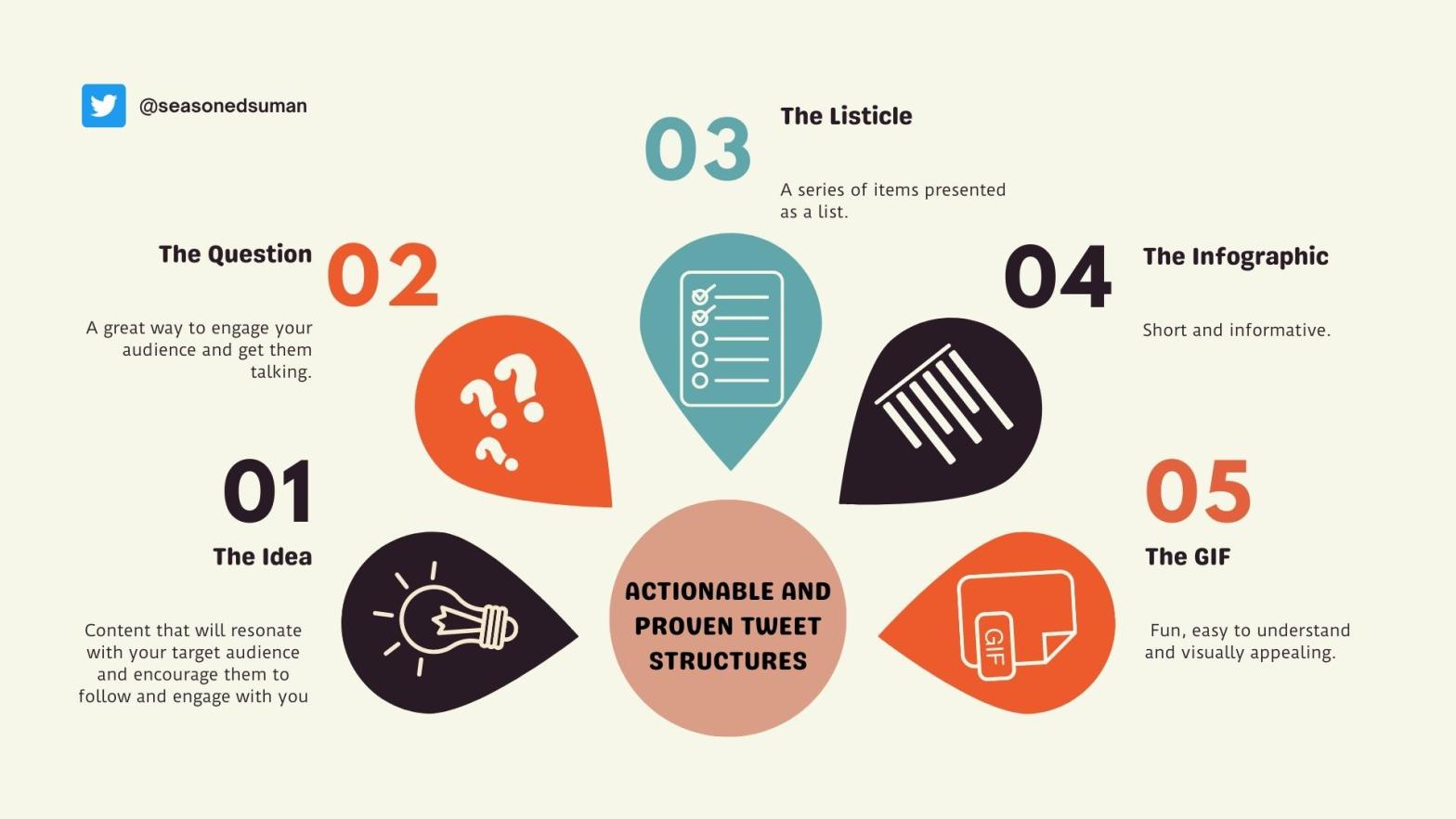
These five tweet structures will help you gain more followers on Twitter.

The Idea

The first step to growing your audience is to build a strong foundation. With this structure, you can create content that will resonate with your target audience and encourage them to follow and engage with you.

  • How-to: A quick how-to on a topic related to your industry or business.
  • Product: A specific product or service offered by the business.
  • Event: An upcoming event or regular event (like a monthly meetup) that people would be interested in attending, such as a webinar about social media marketing for real estate agents or an Instagram party where participants teach each other new editing techniques.

The Question

Asking a question is a great way to engage your audience and get them talking. To make it work, though, you need to make sure that the question is clear and applicable to your target audience. 

The best questions are those that someone in your target market would be likely to ask themselves—and then answer on Twitter.

Here are some examples of good questions:

  • What do you think of my most recent blog post?
  • Which one is better: this app or that app?
  • How do I get a job at [company name]?

The Listicle

The listicle is a great way to get your audience to engage with your tweets and keep them on the platform longer.

A listicle is any post that contains a list of items in order of importance, such as:

10 Reasons Your Husband Will Leave You if You Don’t Stop Binge-Watching Gilmore Girls (#2 Is Really Important)

So What Does Each Outcome Mean for Those Who Are Waiting for Their Visa?

You can also consider extending it into a thread if the tweet gains good engagement.

The Infographic

  • Share the infographic.
  • Copy and paste the URL into your tweet.
  • Add a link to your website at the end of the post.

The GIF

  • Include a GIF in your tweet.
  • Use the GIF to showcase something you’re excited about and also to insert emotion into your tweet.
  • People love GIFs because they’re fun, easy to understand and visually appealing!

Key Takeaway

Using these five proven tweet structures will help you gain more followers on Twitter. The answer is simple: Understand what type of content your audience wants to read and share it with them.

Start collecting tweets that draw your attention and identify the structure. Test them out with your content in your niche. Refine and repeat.

The key here is not just posting good content but also showing that you care about your audience by taking time to craft tweets they’ll love.

­

A Marketer’s Guide to Local SEO and How Local Retailers Can Reach Their Target Audiences

There is no denying the fact that digital marketing is the go-to form of marketing for many modern businesses.

With methods that make it easy for businesses of all sizes to adapt, digital marketing has helped even out the playing field. 

Small businesses no longer have to struggle to keep up with larger businesses and retailers, and it has made it much easier for these small businesses to reach their target audiences. 

In the past, small, local retailers have found it difficult to compete for the same audiences as their larger counterparts. 

With digital marketing, smaller retailers have access to the same audiences, but on a local scale. One of the ways that smaller retailers are able to reach local audiences is through methods like local SEO and through the “Buy Local” movement. 

Here is everything that you need to know about both options and how this can influence the outcome of your SEO campaign.


What Is the “Buy Local” Movement?

There has been a stronger push for customers to buy their products from smaller, local retailers as a way to support local businesses and boost the local economy.

In fact, in 2019, 46% of Americans preferred to shop for their products locally (NielsenIQ, 2021). 

With the pandemic and its effect on retail and shopping, that number has jumped to 57% of consumers looking to buy their products online (Retail Council, 2021).

Because of the stronger support for local goods and services, smaller, local retailers should leverage this to their advantage, which is where local SEO comes in. 

The great thing about this movement is that the support for local businesses is no longer limited to physical mom-and-pop stores.

Consumers are strongly supportive of local businesses on both a physical and online scale.

What Is Local SEO?

With the popularization of the Internet and other online services, it is no secret that consumers make use of these tools to supplement their buying decisions. 

Search engines like Google have picked up on the fact that online users tend to focus their searches on a local scale, and have changed up their algorithms to reflect this. 

Local SEO is a subcategory of SEO that allows businesses to focus their efforts on a more local scope.

This typically involves the optimization of your pages and website through the use of more location-based keywords.


How Does Local SEO Differ from Traditional SEO?

Local SEO is not, in a sense, different from traditional SEO. Local SEO falls under the scope of traditional SEO, and the optimization techniques used in this are the same.

The distinguishing factor in local SEO is the utilization of more location-focused keywords. 

Traditional SEO gives your business the chance to reach anybody, anywhere, as long as they are looking for your offered products and services.

On the other hand, local SEO gives you access to a more targeted, local audience. 

Local SEO gives you access to an audience with a higher conversion rate potential when done properly.

This can also help you make the most out of your SEO budget, which is ideal for smaller businesses.


Building Your Local SEO Strategy

Now that you understand how local SEO works, and what it can do for your business, how do you get started with this? 

The great thing about local SEO is that, if you already have a traditional SEO strategy in place, all you need to do is build on top of this.

Like traditional SEO, it’s important to do keyword research, and optimize your website for local SEO. 

However, your efforts should also include the research of local trends and audiences so that you can optimize this fully for a local audience.

Pinpoint Your Location and Do Your Research

Like any other digital marketing method out there, your local SEO strategy should begin with research. You should first make sure to identify and fully clarify your target location for your SEO strategy. 

Are you only going to be focusing your efforts on your local town? Or do you want to cover the surrounding areas as well? 

Knowing the extent of your target location allows for better optimization of your SEO. 

With local SEO, it is especially important to do your research into the local audience and their purchasing habits, as you need to tailor your SEO strategy to a local audience in order to guarantee its success. 

This will serve as the foundation of your local SEO strategy.


Use Your Research on Your Product Pages

When you’ve done your research into your target audience, you should take all of this information and apply it to your product pages. 

What items do your local audience typically buy as a bundle?

You can offer a bundle deal to encourage bigger sales for certain items. 

Are there any local, seasonal events that trigger the purchase of specific items?

You can anticipate these events and offer special sales or ramp up your SEO and PPC to reach out to your audience during these times.


Optimize Your Pages and Your Entire Website

Your local SEO strategy should be treated the same way that you would your traditional SEO. One of the most important steps to a successful SEO strategy is the optimization of your site’s pages. 

There are a few ways to carry out this optimization. 

If you’re looking to optimize your website for local SEO, you should start by creating meta tiles for all of your product pages using the product name plus business location.

When you’re describing your product or business, place the location keyword in your meta tags. 

Everything on your pages should be optimized, including your site images, so keywords in alt-text should not be neglected. Of course, content is essential in modern SEO practices, so you should never forget to invest in quality copy for your site pages. 

A length of 300 words on each page should be enough for quality optimization.

Use Google My Business

Other Google tools like Google My Business can also benefit your local SEO. As a small, local business, you should make sure to activate your Google My Business profile.

These profiles are tied in with your domain and can help improve your SERPs, especially on a local scale. 

To make sure that this works well for you, your business’s information should be kept up to date.

Some of the information to keep updated includes your shop hours, address, email, contact information, website, social media pages, and any reviews and FAQs. 

If you change any of these pieces of information, you should make sure that your Google My Business reflects those changes. 

Also, if there are any discrepancies between your business and the online information that you have up, then this can affect how users see your business and, subsequently, your SEO. 

Not only that, but keeping your page updated with reviews, images, and FAQs signals to customers that your business is up and active, which encourages users to choose your business over less active retailers.


Final Thoughts

For the longest time, smaller retail stores struggled to compete against larger retailers like Walmart and Amazon. 

After all, these larger retailers are more recognized and they’re working with a seemingly endless pool of resources for their marketing and outreach. 

However, with recent advances in SEO, marketing, and online technology, it is now much easier for smaller businesses to reach the same audiences as these larger retailers. 

Coupled with the push for the support of the local businesses movement and the encouragement to promote the local economy, small, local businesses are now capable of achieving retail success with a local audience. 

As long as you apply the proper SEO methods and optimization techniques, you will find that your local SEO efforts will pay off well for you, allowing you to make the most out of your SEO and digital marketing budget. 

A Guide to Improving Your Chances of Getting That Job You’ve Always Wanted

Need a job? Don’t we all. The job market is tough and even the monsters that run it must have jobs. Got to pay those bills, right?  

From getting your foot in the door to suggestions on what to do when it’s open, here are a couple of helpful tips on how you can improve your chances of landing that job you’ve been eyeing. 

If you’re lucky enough to live in a city with a vibrant and active job market, or if you’ve never had any problems finding a job before — you might easily assume that getting employment has always been relatively straightforward.  

However, this is far from true.   

As recent statistics have revealed, the current state of the global economy makes it harder than ever to get your foot in the door at a new company.  

Therefore, if you’re currently seeking employment, then chances are that you already have some idea that things aren’t as easy as they once were.  

Even worse, it’s possible that you’ve suffered one rejection too many and now don’t even seem to know where to begin looking for a new job.  

But this is all about to change. 

Step 1 – Study the company and research the role. 

Make sure you can uncover everything there is to know about the company and learn about the people who work there. Find out about the team, their culture and their mission. 

Look at all the available information on their website, social media platforms and in their press releases. You can also use LinkedIn and Google to find out more about them if they do not have a website or social media presence. 

Go through the job description, looking for links between your own experience and skills and those asked for by the employer.  

The more you know about this company, the better you can present yourself as a good fit for it.

Step 2 – Questions! Questions? Have a list of insightful questions and be prepared to be asked tough questions. 

Be prepared with questions about the company, industry, team and culture. This shows that you are interested in the role and want to make sure it’s a good fit for both parties. 

Prepare answers in advance. Be ready with examples that illustrate your skills and experience. 

Make sure you understand what the company does, its products or services, and its competitors. You don’t want to ask questions about something they’ve just described as irrelevant to their business. 

The interview is a two-way street, so make sure you ask questions about the company and the role that you are interviewing for.  

Questions like: “What do you like about working here?” or “What does the regular day-to-day look like for this role?” will give you an idea of what it’s like working at that company and if it’s something you can enjoy. 

If they ask you challenging questions, don’t get defensive or flustered; instead, answer honestly and with confidence.  

For example, if they ask how long it will take you to complete certain tasks, be honest with them but also try to give them an optimistic response. 

Saying something like, “I’m confident that I can complete this task in less than three weeks,” shows them that you are confident and committed to doing well on the job; it also gives them an idea of how quickly they can expect results if they hire you. 

Another question would be “Why did you leave your previous employer/company?” This is a tricky question. You want to make sure that your response is done in a positive manner. Avoid any badmouthing – keep it simple and be positive. 

But what if a higher salary is the reason you’re looking for other jobs? A good approach would be to express how your earlier job didn’t offer an opportunity for further growth.  

What this does is that it tells the interviewer that you’re prepared to face new challenges and the pay that comes with it. 

A huge red flag would be complaining about your employer, associates or tasks. 

Lastly, make sure that when answering questions about yourself or your skillset, do not go into too much detail or become overly technical unless specifically asked for. 

Step 3 – Be punctual.  

Show up on time. Being late for an interview is unacceptable in any field.   

If you’re going to be late, call and let the interviewer know as soon as possible. Don’t make excuses — just apologize and offer to reschedule if possible. 

Nothing will make a good impression faster than arriving early and being ready to go when the interview begins.  

If you’re late, you may be seen as disrespectful or disorganized — or both. 

Step 4 – Dress for success – first impressions do matter! 

Regardless of whether the interview will take place online or physically — dress appropriately.  

If you’re interviewing with a professional or executive-level person, dress conservatively and professionally; if it’s a younger company, dress more casually but still in line with what other employees wear.  

In most cases, it’s better not to overdress — especially if you’re interviewing at a casual restaurant or coffee shop — but it’s not necessary to be underdressed either. 

Step 5 – Know and connect with your interviewer. 

Researching the company that’s hiring you is necessary, but don’t stop there.  

It can be difficult to remember your interviewer’s name but if you do it’ll surely leave an impression. Maintaining eye contact as you’re conversing shows that you are paying attention. 

Asking questions about your interviewer’s background can help make you more relatable — plus it will make them like you more.  

It’s also smart to take note of any shared interests or hobbies so that you can bring them up during your conversation (and maybe even ask for a few extra minutes in the end).  

This will put you in a better position to connect with them on a personal level, which will only increase your chances of getting hired.  

Step 6 – Be mindful of your tone and voice

First, let’s be clear about what we mean by “voice.” The voice here refers to your tone of voice, your attitude, and the way you come across to other people when you speak or write. 

It is important to keep in mind that when you communicate with a hiring manager, your job application materials are just as important as your resume.  

In fact, if they don’t like your writing style, they might not even bother reading your resume!  

For example, if they read an email from you with poor grammar and spelling mistakes, they might assume that if you can’t be bothered with basic English skills then how much effort are you going to put into this job? 

I’ve met this with one of my clients as I was tasked with filling open positions for a content writer and virtual assistant role.  

The emails I received were terrible to the point where some applicants would just send a blank email with their resume attached and a subject titled “Virtual Assistant”.  

The effort you put in shows how interested you are in the job and hiring managers can see this in the way you present yourself both verbally and non-verbally.  

Step 7 – Explain the value you’ll bring to the company and why you’re a good fit

When applying for a job, it’s important to think about how you can add value to the company and what you can bring to the table.  

To do this, start by writing down exactly what you’re good at and what your strengths are. Then, think about how those skills would be useful in the position you’re applying for. 

Let’s say you have a great eye for design and attention to detail. You might mention that you have experience designing websites or brochures and therefore could help improve their existing designs. 

If you don’t have much experience in a particular field, think about how your skills could translate into different areas.  

For example, if you know how to write HTML code but not CSS or JavaScript, then maybe mention that your coding skills would make it easier for the company to create their own website rather than outsourcing it to another team member. 

You should also consider any relevant experience you’ve had in earlier jobs or internships that shows why you’re qualified for this position — even if it was unrelated. Your skills will transfer over easily if they were acquired through similar tasks at work before or during school. 

Focus on what you can do for the company/employer.   

The goal of an interview is to show a potential employer how your skills and experience can help the company — not just how they would help you grow personally or professionally.  

So, when answering questions about your qualifications, focus on how they align with the needs of the business rather than talking about what interests you or what kind of work environment would be best for you personally.  

Highlight results-oriented achievements instead of responsibilities alone.  

It’s great if you have experience leading projects from start to finish, but simply listing “Project Manager” on your resume isn’t enough to prove that you have those skills in real-life — especially if it was only one project (or even worse, just one week) during which time nothing went wrong. 

Step 8 – Ask and you shall receive. 

Show and tell the interviewer that you are interested in the job. Simply ask them, as being direct can give you the upper hand over other candidates. 

If you’ve basically ticked everything in the earlier steps then ask with confidence. Don’t forget to smile as well! 

Step 9 – Have an attitude of gratitude – it goes a long way.

Regardless if you got the job or not, you need to make sure to thank your interviewers for their time and the opportunity that they had provided.  

No matter how you feel about the position or the company, be genuine in expressing your gratitude. It will build credibility with them and leave a positive impression on their minds.  

Within 24 hours of the interview, make sure to follow up with a thank-you email. It should be brief and professional, thanking them for their time and consideration of your application. 

Step 10 – Follow-Up and follow through. 

A general rule of thumb would be to give it at least a week until you follow up.   

However, if the interviewer has promised a response by a specific date, contact them and find out where they are in the hiring process. 

Keep your messages brief and polite, most interviewers are more likely to be impressed by your determination and interest in the job. 

Step 11 – Stay focused and be confident but don’t forget to smile and be courteous.  

Avoid being too casual or too stiff, but don’t get overly enthusiastic either.  

Interviews are not always easy, so if there is a pause in the conversation or if the interviewer asks you a question that you don’t know how to answer, don’t panic! As much as possible, try to relax and be yourself. Also, don’t be afraid of silence.   

Try saying something like “That is an interesting question. I will have to think about this one before answering” or “I am not sure how best to answer that question. Let me think about it for a moment” or even “Sorry for being quiet for so long; I was just trying to figure out what you meant by that question”.  

Closing Thoughts  

Ultimately, if you’re looking for employment, it is essential to understand what potential employers are looking for.  

If you want them to hire you, you must sell yourself effectively. And if they like what they see and hear, they’ll be more likely to contact you.  

Make sure you are ready when they do by fine-tuning your resume and cover letter. Then follow that up with a phone call that conveys the passion behind your desire to work there and the enthusiasm you will bring to their organization.   

Give them a reason to choose you, rather than another candidate. And if you follow these steps, your chances of getting the job should increase exponentially.

What You Need to Consider Before Buying a House or Condo in the Philippines

Have you considered buying a house or condo in the Philippines? 

You may have a lot of questions about available housing or condos and the best way to go about making a purchase. 

Whether you’re simply curious about how real estate works in the Philippines, or are on your way to the country to buy property — or even if you’ve been living there for years — this guide will give you useful information to help guide your decision.

Buying a house or condo has its own pros and cons. There are many things you should consider before you buy one. 

If you’re thinking about purchasing a house or condo for yourself or your loved ones, this article is prepared with the steps that must be done if you’re planning to get your own home or condo. 

I’ve compiled these steps during the time my partner and I purchased our very first condo.

What type of property do you want to buy and who are you buying it for?

There are many types of real estate properties in the Philippines, namely: condominiums, house and lots, townhouses, Real Estate Investment Trusts (REITs), lot only, apartment buildings and beachfront properties. 

Determining the ideal type of property to purchase significantly depends on your personal requirements and preferences. 

The type of property that you choose depends on what kind of lifestyle want to live. Some people prefer to live in an apartment building while others prefer living on beachfront property.

It is also critical to take into account other factors such as your future plans for that property and how long you intend on owning it. 

If your foreseeable future involves starting a family, having children and growing old, then it may be in your best interest to purchase a house so that you won’t have to worry about finding new accommodations once your family starts to grow. 

However, if you think that purchasing a condo would better suit your lifestyle, then by all means go for it! 

Given a choice, buying a house over a condo because of the difference in size is the obvious choice. However, buying a house is more expensive than buying a condo unit. 

You can also choose to invest in Real Estate Investment Trusts (REITs). It’s just like stock investing but instead of putting your money into stocks, you are investing in real estate properties. 

The small thing to remember when investing in REITs is that there is a minimum investment that you need to meet.

There are many reasons why you should consider buying real estate in the Philippines. One of them is that the Philippines is one of the fastest growing economies in Asia. 

Another reason why you should invest in real estate in the Philippines is that there are many opportunities for business. Oftentimes, people buy houses and condos because they want to rent them out for business. 

And lastly, there are many opportunities for leisure activities like sightseeing and sunbathing.

How much can you practically afford?

How much are the utility costs? If you’re moving into a condo, this isn’t as big of a problem. It should be included in your amortization fee (association dues). 

Also, consider how much electricity will cost you and what kind of appliances you need for your home (gas vs electric).

But if you’re moving into a house, it’s best to know how much your electric and water bills will be so you know how much it will cost. You can call the local electric and water companies to give you an estimate.


Will you need financing to buy a property? 

One of the greatest decisions that you will face prior to buying a house or condo in the Philippines is whether to use financing or pay in cash.  

There are pros and cons to both options, so before deciding on how you will fund your purchase consider all of the factors involved. 

If you are unable to pay for it with cash, then you may want to take out a mortgage or home equity loan. You will want to review different banks and lenders so that you get the fairest deal possible. 

Also, you should look into construction loans in case there are changes that need to be made after purchasing the property. 

Finally, when looking at financing options make sure that it is something that fits well within your budget so that you don’t end up defaulting on payments later down the road.

Focus on location as it is key.

After deciding on the type of property you’d like to purchase and the budget you have, location is the next key factor to consider. 

The Philippines is a tropical country and so it has a variety of climates. The best time to look for a home is when the weather is not too hot or cold. Make sure to list down the areas you’d like to visit and arrange them by location to make things convenient. 

Now that you have your list, examine the following when you’re choosing a house or condominium:

  1. Transportation

Is it easy to commute to work? Are there public transit options? How far are you from a subway or bus stop? 

Transport is important because it gives you options for leaving your car at home and walking or using public transport instead. Ideally, you’ll want to be close to public transportation and major highways so that you can get around easily and quickly. 

You also want to make sure that there are plenty of parking spaces if you have a car because parking can be hard to find in big cities like Manila and Cebu City. 

If you work in an office building or hospital, it may be easier for you if it’s close by, so look into how close everything is when considering neighborhoods.     

  1. Accessibility

Accessibility is another important thing to consider when choosing a neighborhood or condo complex. You should be able to get around easily with your family without having to worry about traffic jams or other problems when traveling from point A to point B. 

A good neighborhood will have sidewalks and bike paths for pedestrians and cyclists as well as safe roads for motorists.

Can you walk to work or run errands? If not, how far away is public transportation?

Also, make sure you can get good internet service and cell phone reception in your home or apartment complex. 

Having access to these is important for emergency purposes and if you’re also working from home or running an online business.

  1. Safety

Consider your neighborhood. Is the vicinity safe for walking or jogging? Are there places where people congregate after dark, such as parks and playgrounds?

Ask around concerning crime rates and how safe it is to live in that area. If you are looking for extra security, ask about guards or Closed-circuit television (CCTV) systems that are available in the building or surrounding areas. 

Also, visit the area during different times of the day. Make sure to check if the area floods during rainy days as well.

  1. Schools

What are the local schools like? Are they good or bad? Do they offer after-school programs that would be helpful for your child(ren)? 

If you have young children, proximity to schools is essential. Check out airport details such as security screening times and parking availability before committing to an address if you’ll be planning to travel frequently by plane.

  1. Shopping

What kinds of shops and restaurants are nearby? Is there anything you might need on a regular basis — dry cleaning, groceries, hardware store — that you can get close by? 

What’s around the corner from your new home that will help make life easier (if anything)?

Are You Ready For The Investment?

Make sure you’re ready before making any decisions as the type of property will determine how much money you need and how long it will take before seeing any returns from your investment.

Remember to always do your own research even if you’ve been offered some property recommendations by family or friends. 

Before you purchase a house or condo in the Philippines, you need to inspect the developer’s reputation. You should know if they have any history of not finishing projects or if they have ever had any legal problems with previous buyers.

Also, you need to know if the contractor that they hire to build the project has a good reputation for quality work and finishing on time.

You may also choose to hire a real estate broker. Take your time as this is a huge commitment. 

The Final Verdict

Even if everyone dreams of owning a house, it’s not that simple. Buying a house is serious business.

Ultimately, you need to understand its requirements and responsibilities. Nothing compares to having your own home. But before you decide to buy, make sure that you do a lot of research and careful planning. 

I hope my experience will help others in their journey of owning their first home or condo. 

What You Need to Know Before Buying an NFT

When it comes to new technologies, the cryptocurrency market is a breeding ground for scams. However, this hasn’t discouraged you from making your first investment in non-fungible tokens (NFTs). 

There’s just one problem — aside from not knowing the difference between digital kittens and doge with a top hat, you’re not really sure what NFTs are and why they can be worth money in the future. 

Let me give you some background information on NFTs so that your future decisions will be justified and well-considered.

Blockchain is a digital ledger that verifies transactions. When you purchase an NFT, your ownership is recorded on a blockchain so no one else can claim to own it. Ethereum’s blockchain is the technology most used in this regard.

If you’re thinking about investing in NFTs, there are a few things to keep in mind. First and foremost, understand that there is no built-in valuation method for an NFT. 

Unlike stocks or bonds, you can’t look at an NFT and determine its underlying value by looking at a balance sheet or income statement. 

Even if the NFT is backed by a physical asset, like real estate, or commodities like gold or silver, determining the value of that asset as related to the token is a subjective process.

The second thing to keep in mind is that history tells us that most early-stage technologies don’t work out very well as investments.

Until it’s proven otherwise—and even then—be skeptical of new technologies, remember that most fail or underperform, and be prepared for losses if you invest in them.

What are the factors that make one NFT more valuable than another?

When considering whether or not to invest in an NFT (or any digital asset), you should look for certain qualities that might add value to the asset.

There are four basic factors that determine how much an NFT is worth: its scarcity, its collectability, the amount of liquidity in its market, and its utility.

  1. Scarcity

The reason people want to own something unique is that it gives them a sense of exclusivity or specialness; they want everyone else to know that there’s only one of this thing and they have it. 

That’s why, if you’re looking at an NFT, you want to know what makes it scarce. 

For example, if you’re looking at a collectible trading card, you might want to consider who made it and whether its rarity makes it valuable—is it a limited edition or one-of-a-kind? Was it made by a notable artist? Is it part of a limited series? 

What about the platform itself—is there a limit on how many times any given person can use the platform to create an NFT (and thus how many NFTs can actually be created)?

Maybe this asset has been used by celebrities or sold for millions at an auction before being resold on the market. 

  1. Collectibility

Some things are just more desirable than others—but why? That’s where your own judgment comes in. 

To decide whether something has collectibility, you’ll need to consider your personal taste as well as prospective buyers’ tastes. 

Are there other works from this artist on sale for similar prices?

As the market for non-fungible tokens (NFTs) continues to grow, investors may be wondering what they should look for when picking their next investment. 

NFTs are rapidly evolving and becoming more complex, so it’s important to understand the different types of NFTs available and to know what qualities make them valuable. All these things are factors that could potentially make an NFT more valuable.

You also need to understand that NFTs aren’t all alike—there are different types, including collectibles, art, games, and virtual worlds. 

Each has its own unique characteristics that determine its value and how you can use it. For example, collectible NFTs are digital items that represent physical objects or real-world events. 

They can be used in games or on social media platforms to enhance user experiences. Some examples of these NFTs include stickers and memes that users can buy and sell on platforms like Twitter or Discord. 

A good way to think about these types of NFTs is as a virtual item or experience that has some monetary value attached to it—like a limited-edition Pokémon card or trading card game booster pack.

Artwork is another type of NFT that’s gaining in popularity thanks to high-profile sales by well-known artists like Beeple, Edward Snowden, and Mad Dog Jones

  1. Liquidity

The third factor is liquidity, and this is similar to the concept of liquidity in stocks—the ability to turn an asset into cash easily and without significant loss. 

If your market for a given kind of NFT is highly liquid (meaning there are many people interested in buying or selling it), then it’s easier for people to trade their NFTs with each other and get cash for them quickly without having to sacrifice a lot of their value.

  1. Utility

Your NFT may be adorable—it could even be rare—but does your NFT do something useful? 

This may seem like an obvious question – if it doesn’t do anything useful why would you want it? – but what I’m really saying here is that utility may not be apparent at first glance. 

For example, let’s say you have a virtual pet on Polygon in a blockchain game (an adorable little kitten with a bonnet) that plays the Tamagotchi game with you and earns tokens for it. 

In this example, the cat might be cute, but the real use case of the token is the ability to interact with the cat within the Decentralized Applications (dApps).

Key Takeaway

It’s important to have a firm grasp on the underlying value of an NFT in order to determine if its asking price is fair. To do that, you need to consider all of the factors that determine its value.

While NFTs will differ wildly in scarcity, collectability, liquidity, and utility, we encourage everyone to use these factors as a starting point when making their decision. 

If you’re considering buying an NFT then this outline can help you ensure that the expense is well worth the cost.

Although it is possible for an NFT to appreciate and become worth more than its face value, there are plenty of factors that can contribute to the overall value decline. 

Additionally, as new tokens enter the market more frequently, developers will have to work hard to keep their tokens relevant and valuable. 

When you purchase an NFT, it is important to determine if the cost of your item can decline in addition to potentially rising and maintaining a successful long-term investment.

Disclaimer: This is not financial advice. Always do your own due diligence before making any financial decisions.

7 Actionable Lessons to Being a Better YOU

What goes into being a better you?

I’m going to admit that I’m not an expert on being a better version of myself, but I can share the lessons I’ve learned. I’m just like everyone out there, trying to make ends meet, pay my bills, and sometimes thinking that I can’t ever be a good version of myself. 

My life isn’t all sunshine and rainbows, and I have my own rough patches. However, through all the bad times, there are lessons I take away from it. Things that I know would make me a better version of myself.

You need to realize that when you want to become a better you is that you don’t actually know anything. If you think you know everything, you are setting yourself up for failure. 

Even if a situation doesn’t apply to you, it still might teach you a valuable lesson, so be sure to watch out for the little things around you. You should look at every situation from a beginner’s perspective. 

These are the lessons I’ve learned throughout life’s challenging situations.

1. Criticism is a part of life.

You can’t please everyone, and you’ll certainly get your share of criticism throughout your career (and life).

It’s important to understand that most people criticize to make themselves feel better. It’s not personal. Accept it and move on. It doesn’t matter what they think or say, as long as you know you’re doing the right thing.

Focus on what you can control which are your actions, not theirs. 

Criticism will most likely happen especially if you decide to put yourself out there.

I also realized that if I want to have millions of people in my community, play on a bigger stage, and take myself to new heights, I must expect and be prepared for people to disagree with me, misunderstand me, and judge me.

This comes with the territory, and playing a bigger game only amplifies that.

2. Delaying decisions does not make things easier.

The longer you wait to do something, the harder it gets. It’s like going to the gym. If you put it off for a few days, your whole routine gets out of whack and it can take weeks to recover from just one day off.

Examples of this can be seen in HR departments, where having to let go of people who have been so good and loyal to the company isn’t so easy to do.

In some cases, this has to be done in order for the company to hire people that align with their goals and are compatible with the nature of work. 


From a business owner’s perspective, it can be cruel but you have to separate what the business needs versus your own personal feelings. 

Delayed decisions are the heaviest weight you can create for yourself. However, once you’ve committed to a decision, life became a lot lighter and you will be able to gain clarity on your next steps.

A quote by Jerzy Gregorek says, “Easy choices, hard life. Hard choices, easy life”.

In life, we all have easy choices and hard choices to make. If you decide to take the easy route now, it often means you’ll have a harder life later.

If you decide to take the harder route now, it often means you’ll have an easier life later.

The choice is yours.

3. Compartmentalize.

Very often you need to compartmentalize in order to get things done – especially if you want to be successful at multiple things in life (family, work, hobbies, etc). 

You can’t give 100% attention to everything all the time, so you need to find ways of splitting your focus – intentionally or otherwise.

Your business is not personal. Your business is a separate entity.

When I finally decided it was time to let people go, I found it hard to actually execute.

Your business has its own needs.  It is a separate entity. And even if you personally don’t want to make a decision because you don’t want to hurt someone’s feelings, at the end of the day, the business has its own requirements of what it needs to grow.

It has nothing to do with your personal feelings. Specifically, when having an uncomfortable conversation, it is better to say:

“This is what the business needs.” vs. “This is what I need.”

This helps you separate the business from yourself.

4. Action sets you apart.

The most successful people set themselves apart by action, not by words. They make promises and deliver on them, whereas others only talk about what they’re going to do without ever actually doing anything about it.

In James Clear’s book, Atomic Habits, he mentions that every Olympian wants to win a gold medal and every candidate wants to get the job.

What differentiates the winners from the losers if successful and unsuccessful people share the same goals?

The action they take makes all the difference. 

The difference is that successful people take massive action to ensure things go their way. Unsuccessful people get stuck in inaction, which holds them back from achieving their goals.

Unsuccessful people dream about their goals, but they don’t do anything about them.

Taking action means you’re doing something about your dreams instead of just thinking about them.


5. You’re not ready yet.

If you don’t have the business you want, it’s because you haven’t become the person to run it. You need to understand that there’s a certain level of growth that you simply weren’t ready for yet.

I always aspired to have a six-figure business before I reach 30 and felt entitled that it should happen sooner.

The truth is, being a business owner capable of running an 8-figure company has a completely different persona than a business owner running a 5, 6, or 7-figure business.

Be patient – because you probably don’t want a bigger business anyways if you cannot handle the problems you’re going through now.

Your time will arrive when you have demonstrated yourself to be ready.

Simply because something is new, doesn’t mean you aren’t competent in doing it. Don’t confuse inexperience with weakness.

When I’m confronted with hard things, I continually tell myself that I am capable of doing them.

I remember when I was new to creating content and starting my freelance business, I often felt a lot of imposter syndrome. Whenever I didn’t do something right, I’d feel like I wasn’t cut out for it at all.

Years later after getting the hang of things I once thought were difficult, I now learn that the largest setback most new entrepreneurs can make is thinking their inexperience is a weakness – when in reality learning new things just takes time.

Once you arrive at the next level of business, you are now doing a job you are untrained for.

Whenever you reach a new milestone in business and you think you’re done learning, your business will continue to test you.

From this, I discovered there is no end destination, and the day you decide to be an entrepreneur is the day you’ve dedicated yourself to life-long personal development.

Feeling stupid, if anything, is normal. You should feel stupid now and then because it means you’re growing rather than remaining complacent and comfortable.

6. Choice and Circumstance.

Happiness is a choice, not a circumstance.

Every day you should consciously be choosing joy because I can assure you that there is no object, goal, or person that will make you feel happy unless you decide to be.

There are many times in life when the choice to be happy may not come easy. When we lose someone we love, experience illness, or face difficult challenges, it may feel impossible to find happiness. 

However, if we don’t consciously choose to be happy and start moving in that direction, we will only add more stress to our lives.

It’s important to take every opportunity possible to practice happiness and put your mind in a positive state. 

When you’re in a positive state of mind and feeling good about yourself, everything else will fall into place and amazing things will happen all around you.


7. Concentrate on what you’re good at and be consistent!

Many people create great content but only a few create great content consistently. What makes you stand out isn’t a viral post. It’s the consistent value you deliver to your audience.

Remember: Creating content isn’t something you check off and it’s done.

It’s a skill that requires practice and patience. It requires you to focus on your strengths rather than your weaknesses.

Even if you get good at the things you’re bad at, at most you’ll go from a D to a C.

However, if you are able to focus on speeding up the things you’re good at, then you’ll go from an A to an A+++.

It’s a far better use of your time to zone in on the things you’re already gifted at so you can become the best in the world at that one thing instead of focusing on your weaknesses and at best going from below average to average.

Focus on being outstanding and find a career that allows you to be that.

The Bottom Line

These lessons aren’t here to preach to you. They’re here to inspire you to be better. 

Their purpose is not to educate or even change how you already do things but rather to improve how you approach the habits which make up your life. 

Draw from these lessons and watch your life improve in a multitude of ways, starting from the inside and radiating out to the rest of the world.

Hopefully, this piece has given you some solid advice on how to be a better person. 

Obviously, it’s not always easy—slowing down and thinking before you act is really hard—but if you focus on those points that resonate with you and your own personality, you’ll find success. 

Everyone will have a different experience with this series of lessons. 

In the end, though, I’m hopeful that I’ve provided some useful lessons that anyone can use to be a better person.

A Step-By-Step Guide to Better Writing

Writing is hard. Writing really well is even harder. It’s also a skill worth honing and improving every day.

That’s why there’s so much advice out there about how to write better emails and blog posts and landing pages and more. 

But here’s the thing: most of that advice isn’t actionable — it’s boring, generic, or convoluted — or all three at once.

Writing is a skill that’s learned gradually. In the same way, you might learn to play an instrument or become fluent in a foreign language, you improve your writing by reading, analyzing, and doing a lot of writing yourself.

By using this guide for improving your own writing, you can hone your skills as a writer and create concise, informative pieces.

Step #1: Build a Content Generator

Your “content generator” is everything you consume on a daily basis—books, blogs, newsletters, podcasts, etc. These are the inputs that nourish your content output.

This will spark the ideas for the content you create based on the insights from the content you consume.

A natural consequence of the level and consistency of your input quality will be your output quality.  

Build your content generator and revisit it constantly. Add, edit, and remove from it as you see fit.

Step #2: Create Brain Banks

Do you know how sometimes you get the best ideas when you’re not even trying?

Whenever you think of an idea or something particularly insightful, add it to your brain bank so you can go back to it later.

Creating “Brain Banks” allows you to collect the bits and pieces of insights that come throughout the day. 

Here are some ideas:

• Notebooks you carry around

• Notion (or similar apps) on your devices

• Email to yourself

The idea here is to register ideas and insights as they transpire.

Step #3: Immerse Yourself In A Creative-Inducing Environment

If you want to write better, surround yourself with other writers and content creators.

You don’t have to be in the same room with them, either — follow inspiring and informative blogs and join social communities where people share content related to your topic on a frequent basis.

Aside from that, you can create a space and routine that enables you to get into a creative state.

Here’s a useful exercise:

Spend a week recording and scrutinizing your creative tendencies.

• What time did you feel most creative?

• What did you do before this window?

• Where were you?

• Any other observations?

Have a bird’s eye view and examine for patterns. Employ the patterns from the observation week to decide your peak “creative-inducing” environment.

Then establish consistency around it.

For me it is:

• Early morning or late afternoon

• Coffee or Tea

• ASMR sounds (no talking)

• Early morning or late night walks

• LoFi Chill/Relaxing Beats

Manufacture a creative-inducing environment.

Step #4: Draft Fast, Edit Slow

Starting is the hardest part. This is something that even prominent writers and storytellers agree on.

Nothing can be more daunting to writers and storytellers than a blank page.

Draft fast—don’t stress about how poor it is.

Edit slow—write and rewrite as necessary.

I used to spend hours writing and editing my blog posts until they were perfect, but now I focus on speed rather than perfection. 

It takes me less than half the time to write because I’m not spending all my time on drafting. I also write blogs for clients and this has helped me meet their deadlines much more easily

Step #5: Consistency By Building a Habit

It isn’t just all about the writing being good, it’s about the consistency.

One of the most successful comedians of all time, Jerry Seinfeld has a strategy that involves “not breaking the chain”. 

He hangs a huge calendar on the wall and uses a red marker to put an X over every day that he completes his daily writing. Motivated or not, it didn’t matter to him. 

This “Seinfeld Strategy” takes the focus off of each individual performance and instead puts the emphasis on the process which is why it works. 

Make your own “Seinfeld Calendar” and utilize it to build a habit that will take your writing to the next level.

Key Takeaway

You’re now equipped with a great start to building a better writing process, as well as tools and advice to help you write better. 

One thing to note is that this isn’t a prescriptive formula that you can always rely on; in fact, the same writing process will not work for all writers. 

The key is to keep these ideas in mind, accept the ones that resonate with you and your way of writing, and be mindful of how your writing process can improve from there.

NFT Games: 3 Tips to Avoid Rug Pulls and Scams

The NFT marketplace has been exploding in value. From the thousands of applications and tokens on offer, it is easy to get lost in all the noise. An investor’s most important job is to sift through all that noise and find legitimate projects with long-term prospects.

With so many scammy projects emerging, it is always a good idea to stick to the well-established platforms or those that are backed by reputable investors or developers. The NFT space is still in its infancy, and scams are a sad reality of any new and exciting space. 

There are so many NFT games and Dapps on the Ethereum blockchain. Some of them are good, and some of them are bad. Most of them are scams or Ponzi schemes. 

So how do you spot a legitimate one? In this article, we will help you identify them with these tips.

What you need to know before investing in NFT games:

1. Do extensive research and background checks.

The first thing you’d want to do is visit their website. If the website isn’t secure, under-developed or lacks relevant information, such as details about the developers, whitepaper, roadmap, community links, social proof and partners. This is already a red flag.

There are a handful of price-tracking websites for crypto assets for all things crypto-related. These well-known platforms provide accurate, timely and unbiased information. Data in these websites can include cryptocurrency prices, events, links to NFT game websites, communities, whitepaper and compatible crypto wallets among many others.

Aside from the website’s aesthetics and information, you’d also want to know if they have an established team – the people behind the project. Make sure their LinkedIn profiles check out. It is also a plus if the team involved has previous experience building games or has been involved with other successful NFT games.

Another way of keeping yourself informed and updated is through actively engaging with the specific project’s communities. You’ll get an idea if a project is good or not if they have a helpful, engaging and well-informed community. 

2. Beware of all things fake!

If the NFT game is raising money, make sure they have a list of the entire team involved with their relevant information. Projects like Pegaxy have set these up on their website. If they don’t have one, ask why. 

By having the team’s real-life pictures, names and information open to the public, they are now held responsible and accountable for any legal issues that may arise in the future. This provides trust between the investors, gamers and community.

More importantly, don’t invest more than you’re willing to lose – always be prepared for the worst-case scenario. Stay away from games that promise high returns or “passive income”. 

Fake websites, fake technical support, fake offers and giveaways are polluting the NFT gaming space. Avoid clicking suspicious and unfamiliar links you receive from emails, random private messages and prompts asking you to reveal your secret recovery phrase

3. Understand the Tokenomics

Tokenomics helps to illustrate the future worth of an asset. It provides an insight into the profitability of one crypto asset over the other in the future.

An important element for investors that can help them decide which asset will be more profitable to invest in is the tokenomic characteristics. These characteristics include Metcalfe’s law, network effect, and scalability.

Another factor to consider is the liquidity of the marketplace. If there are not enough people buying the NFTs, it’s another sign that the NFT project you’re considering is likely a scam.

Other key elements include the existence of an ecosystem. Is there any app or platform built on top of this NFT or does it exist in a vacuum? You should also be able to find a demo or beta version of the product to play with before committing anything to them. 

One of the most important aspects of tokenomics is that it helps crypto projects achieve a fair distribution of their tokens and grow their communities organically through incentives. The basic aim is to create value for everyone involved in the project — from users and traders to developers and investors.

Bottom Line

Smart NFT gaming communities set clear rules on how players can conduct themselves, what is expected of them, and what is off-limits. 

Scams, shills, and rug pulls are detrimental to the development of gamer culture and in the end, hurt the entire community. The best way to prevent issues with scamming and bad actors is to expect them, be prepared for them, and take clear measures to disallow them from happening.

Design a site like this with WordPress.com
Get started